

MPA History
How Laguna’s Marine Protected Areas came to be
Laguna’s Marine Protected Areas were won through years of public hearings under California’s Marine Life Protection Act (MLPA). Bluebelt members were there, testifying and traveling up and down the state.
- 1999The Marine Life Protection Act becomes law.
- 2000–2003Two attempts to carry out the law fall short, and the effort stops for lack of funding in 2003.
- 2004The MLPA Initiative is launched as a public-private partnership. It divides the coast into regions, each overseen by a Blue Ribbon Task Force.
- 2008Planning begins for the South Coast, from Point Conception to the Mexican border.
- 2009Bluebelt members begin testifying at MLPA hearings, traveling to meetings in Monterey, Santa Barbara, Los Angeles, Long Beach and beyond.
- Oct. 20–22, 2009Blue Ribbon Task Force meeting in Long Beach, one of the biggest of the process. Many Laguna residents came to speak for protecting Laguna’s coast.
- Nov. 10, 2009In Los Angeles, the Task Force unanimously chooses the Integrated Preferred Alternative (IPA), a plan that combines parts of the three proposals from the regional stakeholder group and protects most of Laguna’s coastline.
- Dec. 9, 2009The Fish and Game Commission sends the IPA forward for environmental review.
- Dec. 15, 2010At a hearing in Santa Barbara, the Fish and Game Commission votes 3–2 to adopt a network of Marine Protected Areas from Santa Barbara to the Mexican border.
- 2011The Laguna Bluebelt Coalition is formally founded.
- Jan. 1, 2012Laguna’s Marine Protected Areas take effect.
Ten years later: the Decadal Review
The MLPA calls for California to review its network of Marine Protected Areas every ten years. The first review opened the door to petitions for change, and the Bluebelt asked the State to protect the Last Mile: the reefs at Thousand Steps and Three Arch Bay.
- January 2023The California Department of Fish and Wildlife releases the first Decadal Management Review of the MPA network, with 28 recommendations.
- February 2023The Fish and Game Commission receives the Review at its meeting in Sacramento.
- November 2023The Bluebelt submits Petition 2023-24MPA to extend Laguna’s no-take protection south to the city line, covering Thousand Steps and Three Arch Bay. The petition drew wide support, including from the Acjachemen Nation.
 Adelia Sandoval, Spiritual Overseer (Púul) and Cultural Director of the Juaneño Band of Mission Indians, Acjachemen Nation, at KelpFest. The Acjachemen Nation supported the Bluebelt’s petition.
- Feb. 14–15, 2024The Commission sends 20 MPA petitions, including the Bluebelt’s, to Fish and Wildlife for evaluation.
- March 2026Fish and Wildlife recommends that the Commission not approve the petition, while acknowledging that the extension would add protection: 45% more protected area, 321% more protected rocky intertidal habitat and 176% more protected beach, and would likely benefit fished species.
- May 19, 2026At the Commission’s regional meeting in San Clemente, a very large crowd turns out, and many people testify in support of protecting the Last Mile.
- Oct. 16, 2026At the final hearing in Sacramento, Bluebelt members testify, and the Commission does not approve the petition. The evidence still stands, and the Bluebelt continues working to protect the Last Mile. Read The Last Mile →
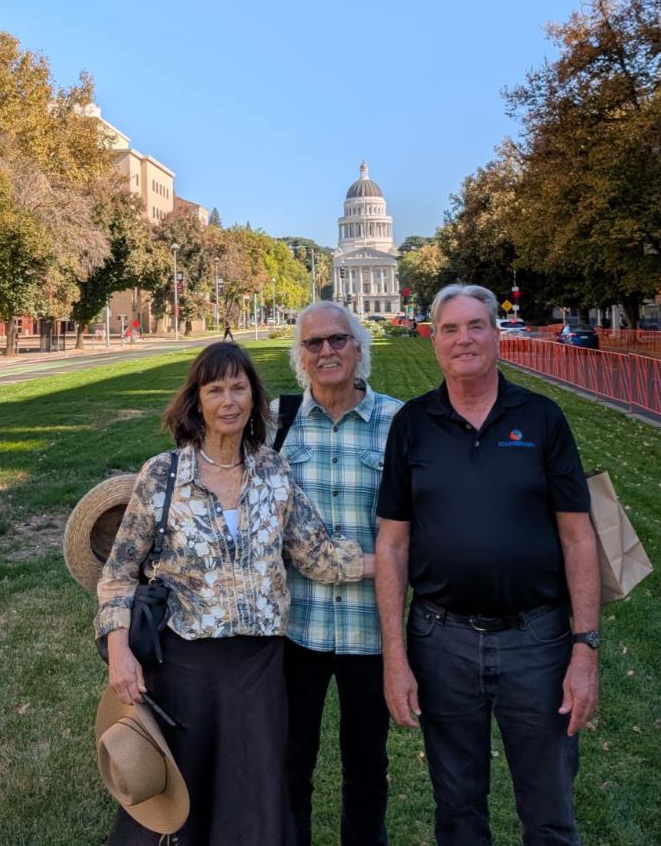 From left: Jinger Wallace and Mike Beanan of the Bluebelt, and Ray Hiemstra of OC Coastkeeper, in Sacramento on the day of the final hearing, October 16, 2026.
More about the MLPA
- Laguna’s Marine Protected Areas — what is protected, where, and what you can do there
- The Last Mile — the case for protecting Thousand Steps and Three Arch Bay
- California’s Marine Protected Areas — the state’s official MPA site, with maps and regulations
- The Decadal Management Review — the State’s ten-year review of the MPA network
- California Fish and Game Commission — meeting schedules, agendas and video archives
“Our past, our present, and whatever remains of our future, absolutely depend on what we do now.”
— Sylvia Earle
Friend’s Corner
We are honored that Sylvia Earle would enthusiastically wear a "Reserve Laguna" button to indicate her support for our efforts.
She has been called "Her Deepness" by the New Yorker and the New York Times, "Living Legend" by the Library of Congress, and the first "Hero for the Planet," is an oceanographer, explorer, author...Learn More

Contact Us · Donate · Get our newsletter · All Pages
© 2011–2026 Laguna Bluebelt Coalition. All rights reserved.
